Fort Mill Commercial Floor Coatings
On a commercial job the coating is rarely the hard part. The calendar is. Carolina Epoxy Coatings installs industrial-grade floors for Fort Mill offices, medical suites, kitchens, gyms, and flex buildings on nights and weekends, so the doors that matter to your business open on schedule.
Call (704) 775-1120 Get a Commercial PriceCoatings Specced to How the Space Gets Used
Fort Mill sits on the I-77 corridor a few minutes over the state line from Charlotte, and the commercial development that followed the interstate south is broader than the bedroom-community reputation suggests. Corporate campuses and office parks brought real daytime headcount across the river. Medical and dental practices opened alongside them to serve the master-planned neighborhoods. Restaurants, breweries, and fitness studios fill the town center and the retail centers off the main crossroads. Light industrial and flex buildings line the interstate frontage. Every one of those floors takes a different kind of abuse, and the system that suits one is wrong for the next, so we spec each Fort Mill commercial job to what the floor has to survive rather than to a catalog default.
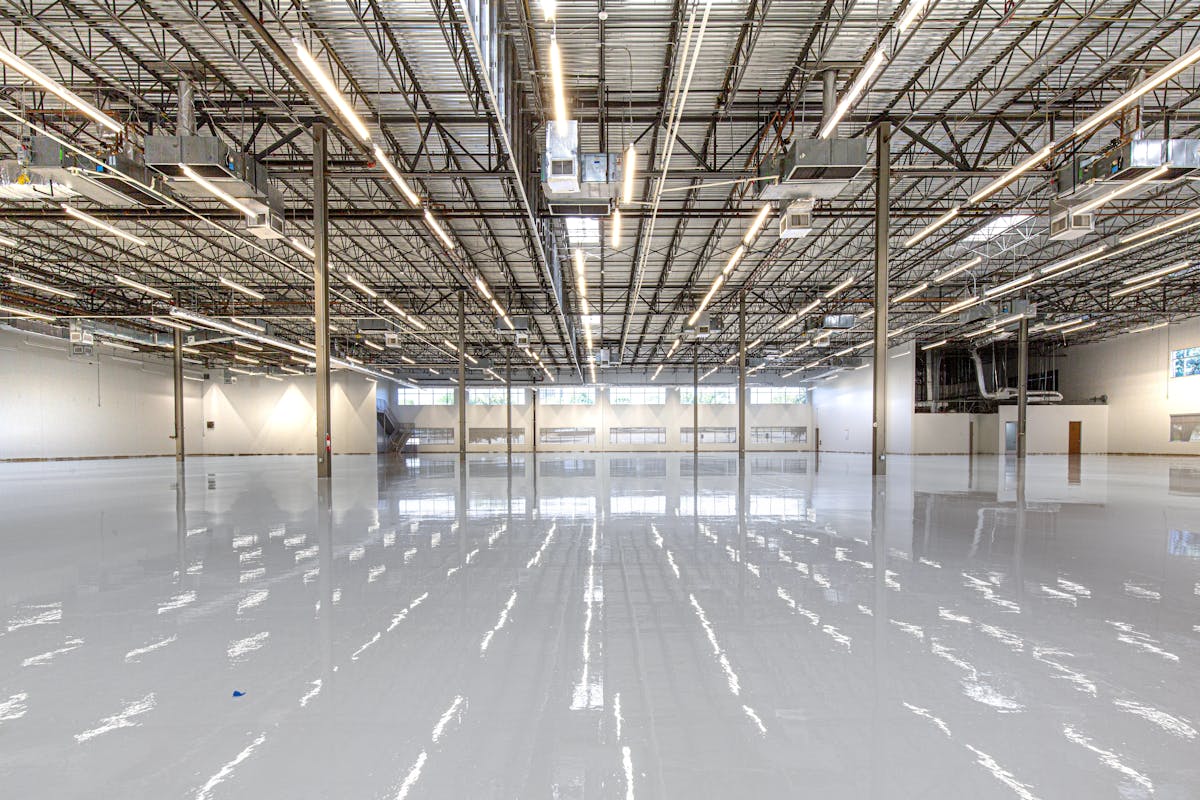
An office park or corporate campus floor usually runs a commercial flake build under a polyaspartic seal: clean underfoot, easy to maintain, and durable under cart and chair traffic. Medical and dental suites need a seamless finish that takes daily disinfecting without clouding or softening, with coved transitions where sterilization and lab work happen. Restaurant and brewery kitchens get urethane or seamless epoxy rated for sanitary service, with texture where the floor stays wet and a coved base at the walls. Fitness studios need a surface that survives dropped weights, rubber transfer, and constant cleaning. Flex and light industrial space along the interstate takes a heavy-mil epoxy broadcast built for pallet jacks, forklifts, and racking loads.
For most Fort Mill businesses the real constraint on a commercial floor is downtime. A week offline costs a restaurant seven services and a dental practice a full week of chairs, and that number dwarfs anything on the material line of the quote. It is the whole reason we lean on fast-cure polyaspartic systems for occupied commercial work. A suite or a shop that closes Friday evening can usually be ground, primed, broadcast, and topcoated across the weekend and open Monday morning on a floor that has cured all the way through. Larger plates get sequenced in zones so half the building keeps running while the other half cures. Nights and weekends are the normal schedule here, not a favor, and you get the hour-by-hour timeline at the site walk so your managers staff around it instead of guessing.
Prep is where an occupied building and an empty shell stop resembling each other. In a shell we run big equipment in daylight and grind the whole plate at once. In a working building the grinders run shrouded and under vacuum with containment at the openings, because dust in a medical suite or a kitchen is a problem long after the floor is finished. We protect casework, inventory, and equipment that cannot be moved, work around whatever the tenant left in place, and stage material through whichever door is available after hours. That work takes longer, and it belongs in the price honestly, which is why a number written for an empty shell does not transfer to the same square footage in an occupied Fort Mill space.
Slip resistance is the spec most often oversold on a commercial floor. Aggressive aggregate genuinely belongs on a kitchen line, in a dish pit, in a brewery cellar, in a gym wet room, and in any entry vestibule where rain tracks in off the parking lot. It does not belong across a dining room, an office suite, or a showroom, where heavy grit only makes the floor harder to clean and does nothing the people using it need. We set the texture zone by zone to where the floor gets wet in practice, and we write it on the quote so nobody is surprised. Call (704) 775-1120, look through finished floors in the gallery, or send over your Fort Mill project and we will set the site visit.
Systems for the Buildings Along the Fort Mill Corridor
Offices, Medical, and Dental Suites
Commercial flake under a polyaspartic seal for corporate campus and office park interiors, and seamless resin where the cleaning protocol is aggressive. Medical, dental, and veterinary rooms see disinfectants, alcohol, and iodine every day, so the topcoat is chosen for chemical hold rather than looks alone, with coved transitions in sterilization and lab areas. Installed after hours so the schedule of patients and appointments never moves.
Restaurants, Breweries, and Fitness Studios
Urethane and seamless epoxy for kitchens and cellars, with integral coving at the wall so there is no seam for grease, water, or product to collect in and nothing for an inspector to question. Texture set to the wet zones only. Gym floors get a build that shrugs off dropped plates, rubber transfer, and daily disinfecting. Weekend installs keep Fort Mill service and class schedules intact.
Flex Space and Light Industrial
Heavy-mil epoxy broadcast for the flex and light industrial buildings along the interstate frontage, rated for pallet jacks, forklifts, and racking point loads, with quartz aggregate in the loading and staging zones. Traffic-lane striping, pedestrian walkways, dock boundaries, and equipment-storage marking go down in the same session, laid out with your team before the topcoat so the lanes match the way the building moves.
More Coatings We Install in Fort Mill
Fort Mill Commercial Coatings FAQ
How long will our Fort Mill space be out of service?
For most spaces, a weekend. A polyaspartic build laid Friday evening takes light foot traffic in about twenty-four hours and full load in forty-eight, so a Monday reopening is realistic on a suite, a kitchen, or a studio. A heavier epoxy system needs closer to seventy-two hours before equipment rolls back in, which is why we usually spec polyaspartic on occupied work. Big floor plates get zoned so part of the building stays open throughout.
Can you coat our building while we are still operating in it?
Yes, and most Fort Mill commercial jobs are exactly that. Occupied work runs on shrouded grinders under vacuum with containment at every opening, because dust travels further than people expect and lands in places a medical suite or a kitchen cannot accept. We protect fixed casework and equipment, sequence the floor in zones, and work nights and weekends. It is slower than coating an empty shell, and we price it that way instead of pretending the two jobs are the same.
Do we need a slip-resistant floor everywhere?
In some rooms, absolutely. Kitchen lines, dish areas, brewery cellars, gym wet rooms, and entry vestibules that catch rain off the lot all get real texture. In a dining room, an office, or a showroom, heavy aggregate mostly makes the floor harder to mop while adding nothing underfoot. We walk the space, mark where water and grease land, and set the texture zone by zone rather than blanketing the whole floor with grit to sound safer on paper.
What does a Fort Mill restaurant or brewery kitchen floor need?
A seamless, cleanable surface with an integral coved base at the floor-to-wall transition, so there is no joint for grease, water, or product to sit in. Urethane systems handle hot water, caustic cleaners, and the acids that come off citrus and beer, and they take thermal shock from a boil-over or a washdown better than standard epoxy. Health inspectors generally look for a surface that is smooth, non-absorbent, and easily cleanable, and this is the build that satisfies that.
Can you stripe traffic lanes in a flex or warehouse space?
Yes. Traffic lanes, pedestrian walkways, dock and staging boundaries, equipment-storage outlines, and color-coded zones are applied as part of the same install, so there is no second mobilization and no waiting on a separate marking crew. We lay the plan out with your operations team before the topcoat goes down so the lines match how forklifts and people move through the building rather than how the floor plan says they should.
What chemicals will the floor see in a gym or a medical office?
Different ones than a warehouse, and that changes the spec. A fitness studio deals with sweat, rubber transfer from dropped plates, and disinfectant sprayed several times a day. A medical or dental suite sees alcohol, iodine, surface disinfectants, and occasionally spilled treatment chemistry. Both need a topcoat that resists staining and softening under repeated cleaning, which is where polyaspartic earns its place. Tell us your cleaning products at the walkthrough and the spec follows from that.
What does the warranty on a commercial floor cover?
Bond and workmanship. If the system delaminates, blisters, or fails to adhere because of how it was installed or what was installed, we come back and make it right. What a warranty does not cover is wear that any floor takes: gouges from dropped steel, abrasion under steel forklift wheels, damage from chemicals harsher than the system was specced for, or cleaning with products that attack the topcoat. Moisture from under the slab is covered when mitigation was specced and installed. We put the terms in writing before the job starts.
Do you carry insurance and coordinate with our property manager?
Yes. We carry general liability and workers’ compensation, and certificates go out on request with additional-insured language for a landlord, property manager, or general contractor, which the Fort Mill office parks and retail centers commonly ask for before a vendor touches a tenant space. On a build-out we slot the floor into the general contractor’s schedule so it cures without holding up the other trades and the opening date holds.