Gastonia Commercial Floor Coatings
Commercial floors in Gastonia take daily punishment from foot traffic, equipment, and spills that a residential system cannot handle. Carolina Epoxy Coatings installs industrial-grade commercial coatings with after-hours scheduling to keep your business running.
Call (704) 775-1120 Get a Commercial PriceCommercial Floor Coatings Built for Gastonia Businesses
Gastonia’s commercial base ranges from distribution warehouses and manufacturing facilities along I-85 to local automotive shops, restaurants, and retail along Franklin Boulevard. Each business type has different floor requirements, and a one-size system does not cover them all. Carolina Epoxy Coatings has installed commercial floor coatings across the full spectrum in Gaston County.
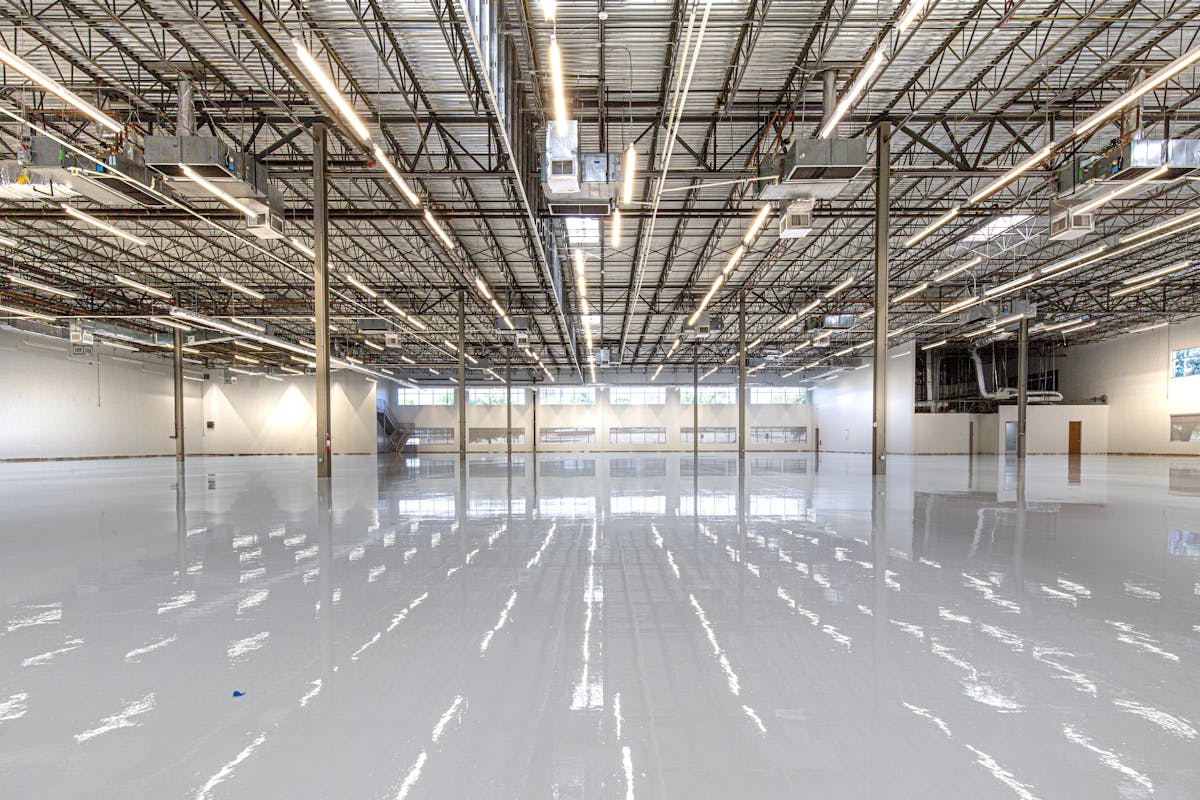
Warehouse and distribution floors need heavy-mil epoxy broadcast systems rated for forklift traffic, pallet jack loads, and chemical resistance to cleaning solutions. Restaurant and food-service kitchens need urethane or industrial-grade broadcast with anti-slip texture rated for USDA sanitary environments. Automotive and mechanical shops need polyaspartic systems with maximum chemical resistance to oils, solvents, and road salt dragged in on vehicles. Retail and professional office spaces can use standard commercial flake epoxy with a polyaspartic topcoat for a clean, durable appearance.
We schedule commercial jobs in Gastonia around your operating hours. Night and weekend installs available for businesses that cannot shut down daytime operations. All installs are fully insured with certificates of insurance provided on request. Contact us at (704) 775-1120 or submit a commercial project request.
Gastonia is an old mill town, and a lot of its commercial buildings show it. The former textile plants and warehouses around Franklin Boulevard and the rail lines were poured decades ago, and those slabs have a story to tell before we coat them. Old oil-soaked machine pads, patched cracks, changes in floor elevation where equipment used to sit, and a hard troweled surface that was never meant to bond to anything. That kind of slab needs real diamond grinding, not a quick acid wash, to open the surface up and give the coating something to grab. We bring walk-behind grinders and, for the big square footage, ride-on planetary machines that profile a warehouse floor fast and pull the dust into HEPA vacuums so your product and your people are not breathing silica.
Older Gaston County slabs also tend to run high on moisture. Many of these buildings were poured before vapor barriers were standard, straight onto Piedmont clay that stays damp under a humid Carolina summer. Before we build a heavy-mil system on a floor like that, we test it. If the moisture reading comes back hot, we roll a moisture-mitigation primer that seals the vapor down so it cannot push the coating loose. A distribution floor that lifts under a forklift six months after install is almost always a moisture failure that a previous crew skipped the test on, and it is the reason we never quote a Gastonia industrial floor sight-unseen.
Cracks and joints get real attention on these floors too. A working warehouse slab moves, and control joints that get flooded flush with epoxy will telegraph a crack straight through the coating the first cold snap. We chase and fill static cracks with a rigid polyurea, honor the moving joints with a flexible filler, and re-cut them through the finished coating so the floor can flex without splitting. That detail is the difference between a floor that looks new in year five and one that spiderwebs by the next winter along I-85.
Commercial Coating Systems for Every Gastonia Industry
Warehouses and Distribution
Heavy-mil 100% solids epoxy broadcast systems rated for forklift and pallet traffic. Chemical resistance to industrial cleaners. Quartz aggregate for anti-slip texture in loading and high-traffic zones. Safety striping lanes and zone demarcation available. 4-7 day install window for large square footages.
Automotive Shops and Service Centers
Polyaspartic systems with full chemical resistance to oil, hydraulic fluid, transmission fluid, brake cleaner, gasoline, and road salt. One-day installs for service bays. Color options in gray, charcoal, and safety yellow zone markings. Resists tire marks and rubber transfer from hot tires.
Restaurants and Food Service
Urethane or seamless epoxy systems appropriate for USDA food-contact environments. Anti-slip texture in kitchen and wet prep areas. Coved base available for floor-to-wall transitions in commercial kitchens requiring seamless sanitary surfaces. After-hours install to avoid service disruption.
Gastonia More Services
Gastonia Commercial Floor Coatings FAQ
Can you install commercial floor coatings after hours in Gastonia?
Yes. Night and weekend scheduling is available for Gastonia commercial projects. We work around your operating hours. Most smaller commercial spaces (under 5,000 sq ft) can be completed in a single overnight window. Larger warehouses require a multi-night schedule. We provide the full project timeline at the site walk.
How long does commercial epoxy take to cure before reopening?
Polyaspartic systems: 24-hour light foot traffic, 48-hour heavy traffic and forklift. Epoxy systems: 24-48 hours light foot traffic, 72 hours for heavy equipment and full load-bearing. We always confirm cure schedule in writing before commercial projects so your operations team can plan around it.
Do you provide certificates of insurance for Gastonia commercial jobs?
Yes. We carry general liability and workers’ compensation insurance. Certificates are issued on request and can name your property management company or general contractor as additional insured.
What commercial floor mil thickness do you install?
Commercial broadcast epoxy systems: 30-40 mil total system thickness. Heavy industrial systems: 60-80 mil. Residential garage systems: 20-30 mil. We specify system thickness in the quote and can provide material data sheets (MDS) for any commercial coating system on request.
Can you do safety striping and zone marking in Gastonia warehouses?
Yes. Traffic lane striping, safety zone demarcation, loading dock boundaries, and equipment storage zones are available as part of any warehouse floor project. Colors: safety yellow, white, red, and custom RAL. Applied in the same session as the coating system.
Can you coat an old textile-mill or warehouse floor in Gastonia?
Yes, and those slabs are a good part of what we do here. Old mill floors come with oil-soaked machine pads, patched cracks, hard troweled surfaces, and changes in elevation. We diamond-grind the whole floor to open it up, cut out and patch the failed areas, and profile it so a heavy-mil system actually bonds. A quick acid wash will not do it on a slab that old, which is why we always walk the building before we quote.
Do older Gastonia slabs have moisture problems?
Often, yes. A lot of the older commercial stock was poured before vapor barriers were standard, right onto Piedmont clay that stays damp through the summer. We test the slab for moisture before building anything heavy on it. If it reads high, we roll a moisture-mitigation primer to lock the vapor down so it cannot lift the coating later. It is the most common reason a warehouse floor fails, and it is cheap insurance to test for it first.
How do you deal with cracks and joints in a working warehouse floor?
We fill static cracks with a rigid polyurea, honor the moving control joints with a flexible filler, and re-cut the joints through the finished coating so the slab can still flex without splitting the surface. Flooding a moving joint flush with epoxy is how a crack telegraphs straight through by the next cold snap. Handling the joints right is what keeps the floor looking clean years down the road.
Talk To Carolina Epoxy Coatings
Reach out today for a fast, no-pressure quote. We look forward to working with you.